



Technical Details
- Description
- Scale guide
- Limited to just 12 pieces
- Accompanied by four A2 archival-grade prints of iconic photographs captured by renowned Formula 1 photographer Richard Kelley and curated by Melanie Villeneuve
- Further authenticated and endorsed with a certificate signed by Melanie Villeneuve
- As raced by Gilles Villeneuve in the United States East Grand Prix at Watkins Glen International Raceway on the 7th of October 1979
- Weathering details precisely applied by artisans in Bristol using archival imagery
- Over 4500 hours to develop the model
- Over 450 hours to build and weather each model
- 1:8 scale model, over 56 cms/22 inches long
- Each model hand-built and assembled by a small team of craftsmen
- Thousands of precisely engineered parts: castings, photo-etchings and CNC machined metal components
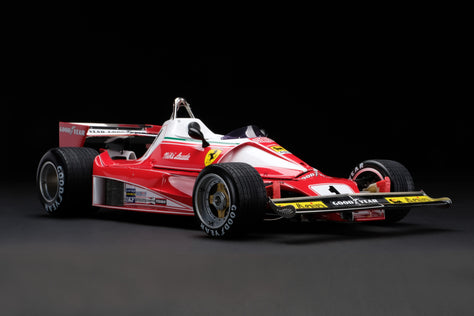
We are pleased to unveil a new Historic Formula 1 Race Weathered edition, capturing Gilles Villeneuve’s 1979 US Grand Prix East winning #12 Ferrari 312 T4. Limited to just 12 pieces, each example is individually weathered by hand at our Bristol workshop to authentically capture the car as it crossed the chequered flag after Villeneuve’s rain soaked victory. We are also delighted to reveal that each model will be accompanied by a certificate signed by Melanie Villeneuve, along with four A2 archival-grade prints of remarkable photographs captured by renowned Formula 1 photographer Richard Kelley back in the day and carefully curated by Melanie Villeneuve.
Showcasing Richard Kelley's Unique Prints
Capturing the defining moments of Villeneuve’s Ferrari career, the extraordinary photographs shot by Richard Kelley in this unique edition have been carefully curated by Melanie Villeneuve, and evoke the iconic era in which her father raced and the focused spirit of a driver who lived to find the limit. Richard Kelley, the renowned Formula 1 photographer, reflected on one of the most remarkable and unforgettable days of his career, saying:
"I will always remember Gilles Villeneuve, alone in his 312 T4, as rain approached and he prepared to win the 1979 United States Grand Prix.
The weather was deteriorating, and as drivers milled about, chewing their fingernails and speaking softly to their engineers, they all had their eyes on the darkening skies. While they waited until the last instant to buckle in, Gilles already sat calmly in his cockpit, belts pulled to near race-tightness; the huge one-piece Ferrari cowling lying next to him on the tarmac.
As was common with Formula One cars then, the aluminium “tub” forming the cockpit of his #041 left his feet extending beyond the front wheels and barely extended above his hips. The remainder of his slender body would be “protected” by that fiberglass cowling and one riveted metal panel attached to the front of the forward triangular tube structure that held the steering wheel and gauges.
It seemed that every Ferrarista in New York State was pushing aggressively to see him, yet there was a “bubble” around Gilles as he sat alone; no small cadre of engineers leaning on the chassis, discussing tactics – no Mauro Forghieri urging him to nail his start.
There simply was no need.
Gilles had devastated the entire field during that weekend’s torrential rain-soaked Friday practice; setting times 22 seconds faster than any Goodyear-shod car, and a staggering 12 seconds faster than teammate and new World Champion, Jody Scheckter. With Scheckter now champion, Gilles was free to race for himself; doing lap after lap on the limit for the sheer joy of it.
He was preparing to do it again.
As he sat in perfect silence, wearing his “race face” as he delicately put on his gloves, the air began to smell of rain. If he was conscious of the worsening conditions, his face never betrayed his emotions. On that day, it was clear he would drive the only way he knew: pedal flat to the stops. You never had to fear Gilles wasn’t up to the challenge, you feared he might go too fast.
The rain arrived 20 minutes before the start, and despite low oil pressure that had him nursing his car to the finish, he would win by 48 seconds."
Melanie Villeneuve, daughter of the racing icon Gilles Villeneuve, further remarked:
"It has been a true pleasure collaborating with Amalgam on this very special edition. These models and Richard Kelley’s photographs beautifully capture not just my father’s car, but the emotion, intensity and spirit of one of the defining moments of his career.
This project is a wonderful tribute to a definitive moment in my Dad's career, a moment of pure racing heart that has been beautifully preserved in this very special edition of models and photography."
Ferrari’s First Ground-Effect Car
A further iteration of Ferrari’s hugely successful 312 T lineage, the Ferrari 312 T4 was the Scuderia’s principal entry for the 1979 FIA Formula 1 World Championship. The T-series had already delivered three Constructors’ titles and two Driver’s Championships in the preceding four seasons, yet by the close of 1978 it faced its sternest test. Lotus’s mastery of ground-effect aerodynamics had overturned the competitive order, forcing Ferrari into a rapid and unfamiliar phase of adaption.
The 312 T4 was Maranello’s response, and a successful one, carrying as Jody Scheckter and Gilles Villeneuve lead the team to both the Drivers’ and Constructors’ Championships.
Engineering a Compromise
For 1979, Technical Director Mauro Forghieri recognised that ground‑effect aerodynamics could no longer be ignored. The challenge lay in adapting an architecture never intended for such principles. The T‑series cars were built around Ferrari’s wide, horizontally opposed flat‑12 engine: potent and reliable, but fundamentally at odds with the narrow underbody tunnels demanded by full ground‑effect design.
The 312 T4, closely derived from the preceding 312 T3, was therefore conceived as a pragmatic compromise. The monocoque was made as narrow as possible, yet engine packaging intruded into the space where fully developed venturi tunnels would ideally sit. In consequence, the T4 functioned less as a pure ground‑effect car and more as a refined wing car, its aerodynamic performance supported by broad sidepods carefully shaped to house radiators and intake ducting.
Extensive revisions were made to minimise drag and recover efficiency. Suspension geometry was redesigned, and the rear brakes were mounted inboard to reduce unsprung mass, improving both traction and consistency. While rivals pursued the fragile extremes of aerodynamic theory, Ferrari leaned on mechanical strength, balance, and engine performance, attributes long synonymous with the T‑series.
Most remarkable was the car’s reliability. Despite being developed under intense pressure and against a shifting technical landscape, the 312 T4 suffered only a single mechanical retirement throughout the season, an extraordinary achievement for the era. This rock‑solid dependability, paired with the flat‑12’s power and drivability, would prove decisive.
Ferrari Back On Top
Ferrari began the 1979 season with the outgoing 312 T3, scoring just three points from the opening rounds in Argentina and Brazil. The debut of the 312 T4 at the South African Grand Prix marked an reversal in form. In difficult, changeable conditions at Kyalami, Gilles Villeneuve led Jody Scheckter home in a decisive Ferrari 1–2, an emphatic signal that Maranello had returned to the front.
Momentum carried through to the United States Grand Prix West at Long Beach, where Ferrari again finished 1-2, Villeneuve once more ahead of his teammate. The Canadian’s electrifying speed briefly placed him at the head of the Drivers’ standings, but the shape of the championship soon became clear. Victory for Scheckter at Spa, from seventh on the grid, followed by a pole-to-flag triumph in Monaco, opened a decisive margin, with the South African 10 points clear by the mid-season mark.
Villeneuve continued to apply pressure, podium finishes in France and Austria reducing the gap to six points with four races to go. At Zandvoort, however, another assured second place for Scheckter extended his advantage, while a dramatic tyre failure while leading ended Villeneuve’s challenge and allowed Ferrari’s rivals back into contention.
The campaign reached its emotional and competitive climax at Monza. Before a crowd of partisan Tifosi, the 312 T4 delivered a commanding 1-2 finish, Scheckter ahead of Villeneuve, securing the Constructors’ World Championships and earning Scheckter the accolade as the first African World Champion. The season closed on a high note, with Villeneuve claiming a podium at his home race in Canada before winning the final round at Watkins Glen, securing second place in the standings.
Overall, the Ferrari 312 T4 claimed six race victories – more than any other team – along with seven further podiums, five fastest laps and two pole positions, amassing 110 points (an additional 3 points were earned by the 312 T3 chassis). While Villeneuve matched Scheckter for outright wins and claimed more podium finishes, often thrilling with his audacity and speed, it was Scheckter’s measured accumulation of points that ultimately proved decisive. This was to be the last Ferrari to take the World Championship until Michael Schumacher’s reign of supremacy began three decades later.
Winner of the 1979 US East GP
This fine 1:8 scale model of the Ferrari 312 T4 is based on Gilles Villeneuve’s #12 car with which he secured victory at the United States Grand Prix (East) at Watkins Glen International Raceway on October 7th, 1979 - the dramatic finale of a season already dominated by Scuderia Ferrari. By the time the championship arrived in upstate New York, Ferrari had secured both the Drivers’ and Constructors’ titles with Jody Scheckter. However, the race itself still carried significance for the Scuderia: Villeneuve was locked in a battle for second place in the Drivers’ Championship, aiming to complete a Ferrari one-two in the standings.
The race was run in treacherous, rain-soaked conditions, contributing to one of the most attritional Grands Prix of the era, with only seven of the twenty-four starters reaching the finish. From the start, Villeneuve demonstrated exceptional car control and racecraft, launching from third on the grid and seizing the lead at the first corner despite the worsening weather. In contrast, his teammate Scheckter was forced wide onto the grass at Turn 1, dropping to the back of the field and leaving Villeneuve to carry Ferrari’s challenge at the front.
As chaos unfolded behind him, with multiple incidents, retirements, and continually evolving track conditions, Villeneuve steadily built and managed his lead. Strategic tyre decisions and the evolving circuit saw rivals briefly challenge, most notably Alan Jones in the Williams, who took the lead on lap 31 before a disastrous pit stop resulted in his retirement, returning control of the race to Ferrari.
Meanwhile, Scheckter mounted an impressive recovery drive, climbing through the depleted field and briefly running second, highlighting both the resilience of the Ferrari team and the durability of the 312 T4 under extreme conditions. However, his race ended in dramatic fashion following a puncture, leaving Villeneuve as Ferrari’s sole contender at the front. In the closing stages, Villeneuve delivered a masterclass in controlled aggression and mechanical sympathy. Unknown to spectators at the time, he had been nursing critically low oil pressure for the final 25 laps, carefully balancing pace with preservation to ensure the car held together while his opponents fell by the wayside. Despite this, he maintained a commanding advantage, ultimately crossing the finish line 48 seconds ahead of Renault’s René Arnoux to secure his third victory of the season.
Villeneuve’s triumph not only underscored his extraordinary skill in adverse conditions but also sealed a dominant Ferrari 1-2 in the Drivers’ Championship standings for 1979. It marked a fitting conclusion to one of the Scuderia’s most successful seasons and would stand as Ferrari’s last Drivers’ Championship victory until the dawn of the Schumacher era two decades later.
This model has been handcrafted and finished in our workshops with the co-operation and assistance of Ferrari regarding original finishes, materials, archive imagery and drawings. The use of supremely accurate digital scanning of the original car has allowed us to perfectly recreate every detail at scale. Furthermore, it has undergone detailed scrutiny by both engineering and design teams to ensure complete accuracy of representation.
The Race Weathered Ferrari 312 T4 is limited to just 12 pieces at 1:8 scale.
Handling Race Weathered Models
Please note that Amalgam’s weathered models are incredibly fragile and require careful handling. We recommend you keep handling to a minimum to avoid removing the weathered effects from the model. When handling the model, please adhere to the instructions included with the product when purchased.

Models you may also like
 In build
Ferrari 312 T2 (1976) - Niki Lauda 1:8 SCALE
 In development
Ferrari 312 T2 (1976) 1:18 SCALE
 In development
Ferrari SF-26 - 2026 Barcelona Grand Prix - Lewis Hamilton 1:8 SCALE
Pre-order
Bespoke
In order for us to create your bespoke model, you will need to choose 4 extra options. Paint colour, interior colour, wheel style and caliper colour.
Please complete the form and a member of our Sales Team will contact you.
Contact Us
Please contact us for more information about ordering this model.