



Technical Details
- Description
- Scale guide
- Limited Edition of 199 pieces
- Replicated exactly as raced to victory by Stirling Moss in the 1955 Mille Miglia
- Bespoke Models can be built to the owner's specification
- Each model hand-built and assembled by a small team of craftsmen
- 1:8 scale model, over 54 cms/21 inches long
- Made using the finest quality materials
- Over 5000 hours to develop the model
- Over 500 hours to build each model
- Thousands of precisely engineered parts: castings, photo-etchings and CNC machined metal components
- Built using original CAD designs developed from a scan of an original car
- Archive imagery, paint codes and material specifications supplied by Mercedes-Benz
The Legend of #722
In the mid‑1950s, Mercedes‑Benz returned to international motor racing with a clarity of purpose few manufacturers have ever matched. At the centre of that effort stood the 300 SLR, a racing sports car developed directly from the W 196 Formula 1 car and engineered with uncompromising discipline. The 300 SLR represented the pinnacle of Mercedes‑Benz’s motorsport ambition in the post‑war era: immensely fast, supremely reliable, and methodically prepared for victory in the world’s most demanding endurance events.
Among the small number of 300 SLRs constructed, chassis 0004/55, achieved a distinction that transcended even the car’s remarkable technical credentials. Driven by Stirling Moss and navigated by Denis Jenkinson under race number 722, it won the 1955 Mille Miglia outright at an average speed never equalled before or since. Its performance was not simply victorious but definitive: more than ten hours of sustained driving at the limit, averaging 99 mph (158 km/h) on public roads, threading through tight city streets and narrow mountain passes. The story of the 300 SLR, and of #722 in particular, lies at the very heart of the motorsport heritage and enduring prestige of Mercedes-Benz.
Born of the W 196 Programme
The origins of the 300 SLR lie in Mercedes‑Benz’s strategic decision to return to top‑level international racing in the early 1950s, its development closely intertwined with that of the W 196 Formula 1 car. From autumn 1953, Mercedes‑Benz engineers, working under the leadership of Rudolf Uhlenhaut, developed a racing sports car in parallel with the Grand Prix programme, intended for the World Sports Car Championship. Internally designated W 196 S, it was conceived for disciplines that demanded durability and versatility as much as outright speed, rather than the narrow specialisation of single‑seater competition.
Progress was deliberate rather than hurried. Although the 300 SLR was initially planned for the 1954 season, its development was temporarily suspended while Mercedes‑Benz concentrated resources on perfecting the Formula 1 programme. Only after success had been secured at Grand Prix level, Juan Manuel Fangio winning his second Drivers’ Championship behind the wheel of a Mercedes, did attention return to the sports racing car. By late 1954, the 300 SLR, the moniker standing for Sport Leicht-Rennen (or Sport Light-Racing), emerged as a highly refined, open‑top machine, though development work continued with relentless intensity.
The engineers’ emphasis lay firmly on robustness and consistency. Engines, chassis, and major components were subjected to punishing test regimes, often covering thousands of kilometres at sustained race speeds. This exhaustive preparation ensured that the finished car would not merely promise performance but deliver it repeatedly under the harshest conditions. By the time the 300 SLR appeared in competition in 1955, it was a fully matured racing tool.
Engineering and Technical Design
At the heart of the 300 SLR lay a three‑litre, straight‑eight engine, derived directly from the W 196 Formula 1 car. Featuring petrol direct injection, dual ignition, and desmodromic valve actuation, the engine represented the pinnacle of mid‑1950s racing technology. Enlarged from the Grand Prix car’s 2.5 litres through increased bore and stroke, it produced between 300 and 310 horsepower at up to 7,500 rpm, depending on intake configuration, figures remarkable for a naturally aspirated engine of the period. To mitigate crankshaft flex at high speeds, power was taken from the centre of the engine via gears rather than from the end, while a rear‑mounted transaxle improved weight distribution.
The engine was mounted longitudinally at a slight angle within an extraordinarily light tubular steel spaceframe, weighing roughly 50–60 kilograms yet providing exceptional torsional rigidity. This frame, an evolution of concepts Uhlenhaut had developed before the war, formed the structural backbone of the SLR, supporting the drivetrain, axles, and aluminium bodywork. With a total weight of approximately 880–900 kilograms in race trim, the 300 SLR achieved an exceptional power‑to‑weight ratio, made all the more impressive by the substantial fuel loads carried in long distance events such as the Mille Miglia.
Suspension and braking systems were equally sophisticated. At the front, double wishbones with torsion bars were employed, while a single‑pivot swing axle at the rear prioritised stability and predictability at high speeds. Large inboard drum brakes, mounted close to the differential, reduced unsprung mass and allowed for greater braking surfaces than conventional outboard designs. In certain events, notably Le Mans, the SLR was further equipped with a hydraulically operated air brake, a rear‑mounted flap that increased aerodynamic drag under braking, reducing strain on the wheel brakes and improving stability. Together, these systems gave the 300 SLR a rare combination of outright speed, endurance reliability, and composure, qualities that would be emphatically proven through its dominance in 1955.
Brief but Brilliant – A Dominant 1955
The 1955 season marked the competitive debut and entirety of the 300 SLR’s racing career. From the outset, the car demonstrated clear superiority over its rivals, combining crushing performance with exceptional durability. Equally at ease on fast permanent circuits and on the punishing public roads of classic endurance races, the SLR proved remarkably adaptable. Its stability, braking performance, and tractable power delivery allowed drivers to sustain extraordinarily high average speeds over long distances without mechanical failure.
Its most celebrated success came at the Mille Miglia, where Mercedes‑Benz secured a commanding one‑two finish, but the victory was no anomaly. The 300 SLR went on to win the Eifelrennen at the Nürburgring, the Swedish Grand Prix, the Tourist Trophy in Ireland, and the Targa Florio in Sicily, each race imposing vastly different demands in terrain, surface, and climate. Across these races, the SLR’s blend of speed, stability, and mechanical resilience proved decisive, repeatedly allowing its drivers to maintain exceptional average speeds over extended distances without compromising reliability.
By season’s end, Mercedes‑Benz had claimed the World Sports Car Championship, completing a year of unprecedented success that also included dominance in Formula 1 and other international categories. Yet the 300 SLR’s competition history cannot be separated from the tragic events of the 1955 24 Hours of Le Mans, where a catastrophic accident involving Pierre Levegh’s car claimed the lives of the driver and dozens of spectators. In the aftermath, Mercedes‑Benz withdrew its remaining entries from the race and later announced its complete withdrawal from works motorsport.
Though Mercedes-Benz’s decision was largely informed by the reallocation of racing resources to production vehicle development rather than a direct consequence of the crash at Le Mans, the result was that the 300 SLR’s competitive career was as brief as it was brilliant, its record frozen at the very height of achievement.
Frozen at the Height of Achievement
Though it competed for only a single season, the 300 SLR achieved a level of success that most racing programmes never approach, let alone equal. Victories in the world’s most demanding endurance events, combined with dominance in championship competition, established it as one of the most effective racing sports cars ever built. Its competition record remains untarnished, preserved intact by the circumstances of history rather than erosion on the track.
Beyond its results, the 300 SLR embodied a philosophy that became central to Mercedes‑Benz’s engineering identity. It stood as a demonstration of what disciplined design, exhaustive testing, and technical certainty could achieve. Lessons learned in areas such as petrol direct injection, lightweight construction, and long‑distance durability fed directly into subsequent production vehicles, shaping generations of high‑performance Mercedes‑Benz road cars long after the racing programme had ended.
More than any individual victory, the 300 SLR came to symbolise a particular racing ethos: methodical, restrained, and devastatingly effective. The decision to withdraw from works motorsport at the end of 1955 lent the car an almost mythic status. Unlike machines that evolve, decline, or are ultimately surpassed, the 300 SLR was frozen at the height of its achievement. It stands today as the final flowering of the original Silver Arrow tradition, and as a lasting statement of what can be achieved when technical excellence and competitive ambition are pursued without compromise.
1955 Mille Miglia
Among the handful of Mercedes‑Benz 300 SLRs constructed, chassis 0004/55, carrying race number 722, is inseparable from the event that would define both car and model. The number denoted its start time, 7:22 a.m. on 1 May 1955, but it would come to signify far more. Entered for the Mille Miglia, a thousand‑mile road race from Brescia to Rome and back, the car was entrusted to Mercedes Formula 1 driver Stirling Moss and navigator Denis Jenkinson. Their task was formidable: more than 1,600 kilometres on public roads, through towns, over mountain passes, and across open countryside, contested against over 500 competitors from across Europe.
From the outset, Moss and Jenkinson approached the race with an intensity that matched the SLR’s engineering. Jenkinson had prepared an unprecedented set of detailed pace notes, condensed onto a long paper scroll and communicated to Moss during the race via a system of hand signals. This allowed Moss to drive much of the route at speeds previously thought unthinkable, even on blind sections. The 300 SLR itself proved perfectly suited to the challenge: stable at high speed, tractable through villages and narrow passes, and capable of sustained flat‑out running for hour after hour. By the time the leading SLRs reached Rome, Moss had taken the lead, setting a relentless pace that few rivals could even attempt to follow.
The return leg to Brescia became an exercise in controlled extremity. Moss drove at the very edge of possibility, yet with remarkable consistency, while the car absorbed the punishment without complaint. After 10 hours, 7 minutes, and 48 seconds, chassis 0004/55 crossed the finish line to claim outright victory. The statistics were extraordinary: an average speed of 157.65 km/h (98.9 mph) over public roads, including tight urban streets and mountain passes. The margin over second‑placed Juan Manuel Fangio, reigning Formula 1 World Champion and driving another 300 SLR solo, underlined the scale of the achievement. It was the fastest Mille Miglia ever run, a record that would never be surpassed.
The victory immediately elevated #722 beyond the status of a successful racing car. It became a symbol of a singular moment in motorsport history, when engineering precision, strategic innovation, and human courage aligned perfectly. Unlike many racing machines, chassis 0004/55 was never tarnished by decline or obsolescence; Mercedes‑Benz’s withdrawal from motorsport later that year froze its achievement in time. Today, the car stands not merely as the winner of the 1955 Mille Miglia, but as the definitive expression of the 300 SLR itself: a car that came, conquered, and departed at the absolute height of its powers.
The Mercedes-Benz 300 SLR #722 is limited to 199 pieces at 1:8 scale.

Models you may also like
![[hide-in-gallery]](http://www.amalgamcollection.com/cdn/shop/products/DSCF6522WIDEEDIT_474x316_crop_center.jpg?v=1724834488)
Ferrari F40 (1987) - US Specification - Rosso Corsa 1:8 SCALE
£17,995.00 GBP
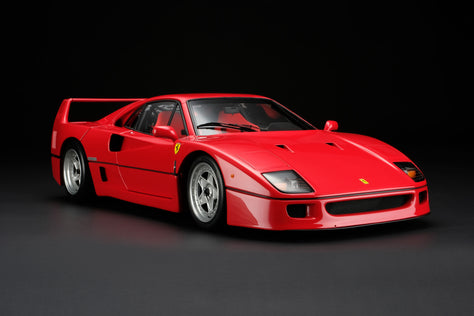
Ferrari F40 (1987) - European Specification - Rosso Corsa 1:8 SCALE
£17,995.00 GBP

Ferrari F12 TDF (2015) - Giallo Modena 1:8 SCALE
£10,025.00 GBP
Pre-order
Bespoke
In order for us to create your bespoke model, you will need to choose 4 extra options. Paint colour, interior colour, wheel style and caliper colour.
Please complete the form and a member of our Sales Team will contact you.
Contact Us
Please contact us for more information about ordering this model.