


Technical Details
- Description
- Scale guide
- Limited Edition of 499 pieces per livery
- The #83 Hypercar edition is based on the car driven to victory by Robert Kubica, Yifei Ye and Phil Hanson in the 24 Hours of Le Mans at Circuit de la Sarthe on the 14th and 15th of June 2025
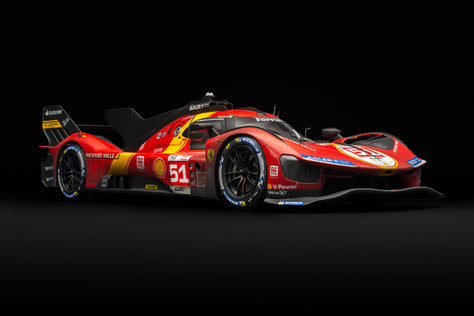
- The #51 Hypercar edition is based on the car that achieved third position in the hands of Alessandro Pier Guidi, James Calado and Antonio Giovinazzi
- The #50 Hypercar edition is based on the car raced by Miguel Molina, Antonio Fuoco and Nicklas Nielsen
- Each model hand-built and assembled by a small team of craftsmen
- Complete with opening doors and engine cover
- 1:8 scale model, measuring over 63 cms/ 25 inches long
- Over 4000 hours to develop the model
- Over 400 hours to build each model
- Made using the finest quality materials
- Thousands of precisely engineered parts: castings, photo-etchings and CNC machined metal components
- Built using original CAD designs based on scans of a real car
- Original paint codes and material specifications supplied by Ferrari
- Officially licensed 24 Hours of Le Mans product
The car that returned Scuderia Ferrari to the pinnacle of sportscar racing, the 499P represents the marque’s first venture into the Hypercar class of the FIA World Endurance Championship, and has since carried Ferrari to three consecutive victories at the legendary 24 Hours of Le Mans. Introduced for the 2023 season, the 499P marked Ferrari’s first appearance in the top tier of endurance racing in half a century. Its strength in competition culminated in 2025 with the capture of both the Hypercar World Endurance Manufacturers' Championship and the Hypercar World Endurance Drivers' Championship.
Winning DNA
Whilst the car is undeniably designed to lead Ferrari into the future, the 499P moniker evokes the history of the Maranello manufacturer, a naming system dating back to its previous Le Mans entries; the 499 refers to the unitary displacement of its engine, while the P stands for Prototype. The Hypercar also sports a livery in the same colours as the 312P from 1973 as a nod to Ferrari's last involvement in endurance racing half a century ago, recalling a long association with a competition core to the DNA of the Ferrari brand. The cars’ race numbers were decided for similar reasons – the number 50 highlighting the length of time that Ferrari had been absent from the top class at Le Mans, and the number 51 has adorned a winning Ferrari GT car on four occasions.
New Hybrid Power and Innovative Technology
In defining the 499P, Ferrari drew upon their vast resources of technical, professional and human excellence that epitomise the Maranello marque, entrusting the management to Attività Sportive GT, under the direction of Antonello Coletta and the technical supervision of Ferdinando Cannizzo, head of the department in charge of engineering and development of Sports and GT racing cars. The design, whilst restricted by aerodynamic and packaging requirements, remains unmistakably a Ferrari, unsurprisingly for a car purely designed and manufactured in Maranello, refined with the support of the Ferrari Styling Centre under the direction of Flavio Manzoni. The car’s technical and aerodynamic features have been enhanced by means of simple, sinuous shapes: an explicit expression of Ferrari’s DNA. The balance between tense lines and flowing surfaces, expressed in a futuristic, pure and iconic language, defines a clear yet essential architecture. Sculpted bodywork encourages aerodynamic flows through the side pods, cooling the radiators concealed beneath. The wheel arches are characterised by large louvres and, together with the headlight clusters, imbue the nose with a sense of character and expressiveness, with subtle references to the styling traits first introduced on the Ferrari Daytona SP3. The rear is the ultimate expression of how to blend technology, aerodynamics and design; a subtle carbon-fibre skin covers the various functions, leaving the wheels and suspension completely visible. The tail is characterised by a double horizontal wing; the main wing and upper flaps have been meticulously designed to guarantee the necessary downforce and achieve maximum performance. The lower wing also features a ‘light bar’ that enriches the rear design with a decisive yet minimalist touch.
Built on an all-new carbon-fibre monocoque chassis, the 499P features solutions that represent the cutting edge of motor sport technology. Double wishbone, push-rod-type suspension provides an outstanding damping stiffness, the benefits of which are felt on the straights as well as when cornering. The electronics systems are developed from and further innovate upon the experience honed in the world of GT racing. The Hypercar features a hybrid powertrain, combining a mid-rear power unit with an electric motor powering the front axle, and is coupled to a seven-speed sequential gearbox. The 2.9-litre, twin-turbo V6 used is the same engine used in the 296 GT3 and its road-going cousins, with a maximum power output of 500kW (680cv). Added here is an Energy Recovery System (ERS) that’s connected to the front axle, and fed by a brake-by-wire system. The ERS is good for 200 kW, and the battery that powers it uses know-how accrued from Ferrari’s vast F1 experience. Among the specific characteristics of the 499P's V6 is the fact that the engine is load-bearing and therefore performs a valuable structural function, compared to the versions fitted to competition GT cars, where the engine is mounted onto the car’s rear sub-chassis.
Competition History
The Ferrari 499P is managed on track by Maranello technicians and engineers with the collaboration of Racing Partner AF Corse, extending the long-successful partnership that began back in 2006. For the 2023 FIA World Endurance Championship (WEC) season, Ferrari GT racers Antonio Fuoco, Miguel Molina and Nicklas Nielsen took control of the #50 car, whilst two-time LMGTE Pro World Champions Alessandro Pier Guidi and James Calado were joined by Ferrari’s Formula 1 Reserve Driver Antonio Giovinazzi behind the wheel of the #51 sister car.
The eagerly awaited debut of the 499P would come at the 1000 Miles of Sebring, with the #50 car establishing an early benchmark by securing pole position. However, despite leading off the line, the Ferrari would be overtaken by the two Toyota Gazoo Racing entries, eventually finishing third, claiming a podium on Ferrari’s return to Prototype endurance racing. Ultimately the 499P was often outpaced by the Toyotas, who secured the title for a fifth year in succession, but Ferrari remained ahead of the other manufacturers. After only once failing to secure a podium all season, Ferrari AF Corse were the only real challengers to the Japanese team, and both cars took the championship battle to the season finale in Bahrain. The highlight of the season though came at the famed 24 Hours of Le Mans: the #50 again qualifying on Hyperpole, but it was the #51 car with Pier Guidi, Calado and Giovinazzi that would secure a victorious return to Circuit de la Sarthe after an intense and dramatic contest. The #50 crew would ultimately finish third in the Drivers’ Championship, with the #51 just six points behind in fourth position.
For the 2024 season, Ferrari AF Corse introduced a third 499P: the #83, raced by official Ferrari drivers Yifei Ye and Robert Shwartzman, and FIA WEC LMP2 champion and Formula 1 race winner Robert Kubica. It was at Le Mans again that the 499P would shine: this time, it was Fuoco, Molina and Nielsen in the #50 who registered outright victory, claiming Ferrari’s eleventh success at the race. The #83 earned a victory at the Lone Star Le Mans in Texas, holding a charging Toyota back to win by just 1.780s, the second closest finish between rival manufacturers in WEC history. In an ever-increasingly competitive championship featuring nine separate manufacturers, the team remained in the fight for the title until the final race of the season, ultimately finishing behind Toyota and Porsche. The #50 crew finished second in the Drivers’ Championship, whilst the #51 and #83 crews were separated by just two points in eighth and ninth positions.
In 2025, the #51 and #50 crews remained unchanged, while Phil Hanson replaced Robert Shwartzman in the #83 team. The season started perfectly in Qatar, with the #51 crew claiming the Hyperpole. They maintained control for the first few hours, until a string of penalties relegated them back into the pack, allowing the #50 and #83 Ferraris to battle for the lead. Ultimately, Fuoco produced a stellar stint to overhaul the privateer entry and claim victory for the #50. The #51 showed resilience, fighting back to claim the final podium place, marking Ferrari’s first top three lockout since the 1,000 Kilometres of Österreichring in 1972. In Imola, the #51 secured pole for a second straight race, with the #83 starting second. The #51 controlled the early stages but two disruptive safety car periods kept the fight for victory wide open into the latter stages. The #51’s decisive move came in the final 30 minutes as Pier Guidi pitted for fuel, saving crucial seconds and rejoining just ahead of their rivals from BMW and Alpine. He held firm to the finish, clinching victory in front of a passionate home crowd of Tifosi, and giving the #51 car its first WEC win since Le Mans in 2023. The #83 finished in fourth place. At Spa, after a dominant qualifying performance, the #50, #83, and #51 cars lined up as the front three on the grid. Despite fierce competition, especially from Alpine, the #51 and #50 achieved a 1-2 finish, securing Ferrari's third consecutive win of the season. Ferrari arrived at Le Mans as favourites following their recent successes, but results from qualifying were less than ideal: the #50, #51 and #83 started seventh, eleventh and thirteenth respectively. This time, it was the #83 that would prevail, earning Ferrari their third successive Le Mans victory with a third different car. Kubica became the first Polish driver to win at Le Mans, Ye the first Chinese racer, while Hanson would become the 35th British driver to achieve victory at La Sarthe. The #51 claimed third position, as only the #6 Porsche and a technical infringement for the #50 stopping the Scuderia from claiming all three spots of the podium.
Ferrari ultimately captured its first Hypercar World Endurance Manufacturers' crown, underlined by a dominant lockout of the top three places in the Hypercar World Endurance Drivers' Championship by Ferrari-powered crews. The #51 partnership of Calado, Giovinazzi and Pier Guidi secured the world title, chased home by the #83 and #50 teams. AF Corse’s triumph in the FIA World Cup for Hypercar Teams completed a commanding sweep of Hypercar honours for Ferrari power.
24 Hours of Le Mans, 14th and 15th of June 2025
These fine 1:8 scale models faithfully recreate the #83, #51, and #50 Ferrari 499P Hypercars that competed in the 24 Hours of Le Mans at Circuit de la Sarthe on 14–15 June 2025. The #83 AF Corse entry secured Ferrari’s third consecutive overall victory at Le Mans, while the #51 claimed the final podium position. The #50 car crossed the line in fourth but was later disqualified due to a technical infringement.
Ferrari arrived at the 2025 edition of the 24 Hours of Le Mans on the back of three consecutive race wins in the FIA World Endurance Championship, making their trio of 499P Hypercars favourites for overall victory. However, an extremely competitive qualifying session saw the #50, #51, and #83 Ferraris start from seventh, eleventh, and thirteenth on the grid — far from the ideal front-row lockout the team had hoped for.
The race began under clear skies, with the Ferraris immediately attacking to recover from their mid-grid positions. The opening laps were frantic, with Hypercars jostling for every position before the first encounters with traffic on lap seven intensified the battles. By the second hour, the #50 Ferrari AF Corse entry surged past the #38 Cadillac with Nicklas Nielsen overtaking on the Mulsanne. Nielsen then reeled in the #12 Cadillac, executing a clinical pass before chasing down the #6 Porsche for second, using superior traction to pass through the second chicane. By hour three, with Antonio Fuoco at the wheel, the #50 moved into the lead, while the #51 and #83 continued their charge, dispatching rivals to climb into the top four.
Shortly after the four-hour mark, the #51 and #83 Ferraris muscled past the #6 Porsche, and all three 499Ps were competing for the lead. Kubica in the #83 received a five-second penalty for a track limits infraction but responded with an incredible stint as night fell, taking the #83 into the lead. In the hands of Yifei Ye and then Phil Hanson, the #83 extended its stints compared to the factory-run cars and, by midnight, held a slender lead of under two seconds over the #51. Meanwhile, the #50 incurred a drive-through penalty that dropped it to fourth, with just 37 seconds covering the top five.
A lock-up by Hanson allowed James Calado in the #51 to seize the lead, but a series of setbacks soon hit the red car: a front-left puncture, a five-second penalty for contact with an LMGT3 Corvette, and another penalty for speeding in the pit lane, dropping the #51 to eighth. The lead cycled between the #6 Porsche, #8 Toyota, and the yellow #83 Ferrari as pit strategies and track conditions evolved. After a slow Porsche pit stop, Ye passed the #8 Toyota to reclaim the lead for the #83, with the #51 and #50 recovering to third and fifth positions. Immediately after a yellow flag period, Calado in the #51 overtook the #83 again, building a healthy lead of over thirty seconds. However, during a routine pit stop, Alessandro Pier Guidi spun the #51 heading into the pits, nearly beaching the car in the gravel. Although he recovered, the spin cost fifty seconds, dropping the #51 back to third and handing the lead back to the #83, closely pursued by the #50 and the #6 Porsche.
After 24 hours of relentless racing, the #83 Ferrari 499P held firm to cross the line first, thanks to a superb final four-hour stint by Robert Kubica. Completing 374 laps, the #83 secured Ferrari’s twelfth overall victory at Le Mans — the first outright win for a privateer Ferrari entry since 1965 — and guaranteed Ferrari permanent possession of the winners’ trophy, awarded to any manufacturer achieving three consecutive victories. The triumph also marked historic firsts: Robert Kubica became the first Polish driver to win Le Mans; Yifei Ye, the first Chinese driver; and Phil Hanson celebrated his maiden Le Mans victory, becoming the 35th British driver — and third to do it with Ferrari — to win at La Sarthe. For Kubica and Ye, the win was especially poignant after the heartbreak of losing an LMP2 class victory on the final lap in 2021, while for Kubica, the result completed an emotional journey after missing his chance to race in Formula 1 with Ferrari due to a devastating rally accident in 2011.
The #51 finished on the podium in third — securing its third consecutive Le Mans top-three after victory in 2023 and third in 2024 — as the #6 Porsche claimed second place as the factory Ferraris slowed late in the race to protect their power units. The #50 crossed the line fourth but was later disqualified for a technical infraction related to bolts in the car’s rear wing.
The 2025 Le Mans Ferrari 499P is limited to 499 pieces per livery at 1:8 scale.

Models you may also like
 Pre-order
Ferrari 499P - 2025 Le Mans Winner - Race Weathered 1:8 SCALE
 Pre-order
Ferrari 499P - 2023 Le Mans Winner - Race Weathered 1:8 SCALE
 Pre-order
Ferrari 499P - 2023 Le Mans 1:8 SCALE
Pre-order
Bespoke
In order for us to create your bespoke model, you will need to choose 4 extra options. Paint colour, interior colour, wheel style and caliper colour.
Please complete the form and a member of our Sales Team will contact you.
Contact Us
Please contact us for more information about ordering this model.