


Technical Details
- Description
- Scale guide
- Limited Edition of 51 pieces
- Based on the #51 Hypercar as raced to victory by Alessandro Pier Guidi, James Calado and Antonio Giovinazzi in the 24 Hours of Le Mans on the 10th and 11th of June 2023
- Weathering details precisely applied by artisans in Bristol using archival imagery
- 1:5 scale model, over 100 cms/40 inches long
- This is a 'Kerbside' model and does not feature any moving parts
- Each model hand-built and assembled by a small team of craftsmen
- Made using the finest quality materials
- Over 4000 hours to develop the base model
- Over 450 hours to build and weather each model
- Thousands of precisely engineered parts: castings, photo-etchings and CNC machined metal components
- Built using original CAD designs based on scans of a real car
- Original paint codes and material specifications supplied by Ferrari
- Officially licensed 24 Hours of Le Mans product
25 models have been ordered by one of Amalgam's most important customers. Only 21 pieces remain in the limited edition.
We’re delighted to introduce the most recent in our ever-expanding series of Race Weathered models: the Ferrari 499P, as raced to victory at the 24 Hours of Le Mans in 2023. This special edition of just 51 models will be meticulously hand-painted and detailed by our master model makers to show every detail of the race dirt as the car as the car was driven to victory by Alessandro Pier Guidi, James Calado and Antonio Giovinazzi in the 24 Hours of Le Mans on the 10th and 11th of June 2023.
The car that returned Scuderia Ferrari to the pinnacle of sportscar racing, the 499P represents the marque’s first venture into the Hypercar class of the FIA World Endurance Championship, and has since carried Ferrari to three consecutive victories at the legendary 24 Hours of Le Mans. Introduced for the 2023 season, the 499P marked Ferrari’s first appearance in the top tier of endurance racing in half a century. Its strength in competition culminated in 2025 with the capture of both the Hypercar World Endurance Manufacturers' Championship and the Hypercar World Endurance Drivers' Championship.
Winning DNA
Whilst the car is undeniably designed to lead Ferrari into the future, the 499P moniker evokes the history of the Maranello manufacturer, a naming system dating back to its previous Le Mans entries; the 499 refers to the unitary displacement of its engine, while the P stands for Prototype. The Hypercar also sports a livery in the same colours as the 312P from 1973 as a nod to Ferrari's last involvement in endurance racing half a century ago, recalling a long association with a competition core to the DNA of the Ferrari brand. The cars’ race numbers were decided for similar reasons – the number 50 highlighting the length of time that Ferrari had been absent from the top class at Le Mans, and the number 51 has adorned a winning Ferrari GT car on four occasions.
New Hybrid Power and Innovative Technology
In defining the 499P, Ferrari drew upon their vast resources of technical, professional and human excellence that epitomise the Maranello marque, entrusting the management to Attività Sportive GT, under the direction of Antonello Coletta and the technical supervision of Ferdinando Cannizzo, head of the department in charge of engineering and development of Sports and GT racing cars. The design, whilst restricted by aerodynamic and packaging requirements, remains unmistakably a Ferrari, unsurprisingly for a car purely designed and manufactured in Maranello, refined with the support of the Ferrari Styling Centre under the direction of Flavio Manzoni. The car’s technical and aerodynamic features have been enhanced by means of simple, sinuous shapes: an explicit expression of Ferrari’s DNA. The balance between tense lines and flowing surfaces, expressed in a futuristic, pure and iconic language, defines a clear yet essential architecture. Sculpted bodywork encourages aerodynamic flows through the side pods, cooling the radiators concealed beneath. The wheel arches are characterised by large louvres and, together with the headlight clusters, imbue the nose with a sense of character and expressiveness, with subtle references to the styling traits first introduced on the Ferrari Daytona SP3. The rear is the ultimate expression of how to blend technology, aerodynamics and design; a subtle carbon-fibre skin covers the various functions, leaving the wheels and suspension completely visible. The tail is characterised by a double horizontal wing; the main wing and upper flaps have been meticulously designed to guarantee the necessary downforce and achieve maximum performance. The lower wing also features a ‘light bar’ that enriches the rear design with a decisive yet minimalist touch.
Built on an all-new carbon-fibre monocoque chassis, the 499P features solutions that represent the cutting edge of motor sport technology. Double wishbone, push-rod-type suspension provides an outstanding damping stiffness, the benefits of which are felt on the straights as well as when cornering. The electronics systems are developed from and further innovate upon the experience honed in the world of GT racing. The Hypercar features a hybrid powertrain, combining a mid-rear power unit with an electric motor powering the front axle, and is coupled to a seven-speed sequential gearbox. The 2.9-litre, twin-turbo V6 used is the same engine used in the 296 GT3 and its road-going cousins, with a maximum power output of 500kW (680cv). Added here is an Energy Recovery System (ERS) that’s connected to the front axle, and fed by a brake-by-wire system. The ERS is good for 200 kW, and the battery that powers it uses know-how accrued from Ferrari’s vast F1 experience. Among the specific characteristics of the 499P's V6 is the fact that the engine is load-bearing and therefore performs a valuable structural function, compared to the versions fitted to competition GT cars, where the engine is mounted onto the car’s rear sub-chassis.
Competition History
The Ferrari 499P is managed on track by Maranello technicians and engineers with the collaboration of Racing Partner AF Corse, extending the long-successful partnership that began back in 2006. For the 2023 FIA World Endurance Championship (WEC) season, Ferrari GT racers Antonio Fuoco, Miguel Molina and Nicklas Nielsen took control of the #50 car, whilst two-time LMGTE Pro World Champions Alessandro Pier Guidi and James Calado were joined by Ferrari’s Formula 1 Reserve Driver Antonio Giovinazzi behind the wheel of the #51 sister car.
The eagerly awaited debut of the 499P would come at the 1000 Miles of Sebring, with the #50 car establishing an early benchmark by securing pole position. However, despite leading off the line, the Ferrari would be overtaken by the two Toyota Gazoo Racing entries, eventually finishing third, claiming a podium on Ferrari’s return to Prototype endurance racing. Ultimately the 499P was often outpaced by the Toyotas, who secured the title for a fifth year in succession, but Ferrari remained ahead of the other manufacturers. After only once failing to secure a podium all season, Ferrari AF Corse were the only real challengers to the Japanese team, and both cars took the championship battle to the season finale in Bahrain. The highlight of the season though came at the famed 24 Hours of Le Mans: the #50 again qualifying on Hyperpole, but it was the #51 car with Pier Guidi, Calado and Giovinazzi that would secure a victorious return to Circuit de la Sarthe after an intense and dramatic contest. The #50 crew would ultimately finish third in the Drivers’ Championship, with the #51 just six points behind in fourth position.
For the 2024 season, Ferrari AF Corse introduced a third 499P: the #83, raced by official Ferrari drivers Yifei Ye and Robert Shwartzman, and FIA WEC LMP2 champion and Formula 1 race winner Robert Kubica. It was at Le Mans again that the 499P would shine: this time, it was Fuoco, Molina and Nielsen in the #50 who registered outright victory, claiming Ferrari’s eleventh success at the race. The #83 earned a victory at the Lone Star Le Mans in Texas, holding a charging Toyota back to win by just 1.780s, the second closest finish between rival manufacturers in WEC history. In an ever-increasingly competitive championship featuring nine separate manufacturers, the team remained in the fight for the title until the final race of the season, ultimately finishing behind Toyota and Porsche. The #50 crew finished second in the Drivers’ Championship, whilst the #51 and #83 crews were separated by just two points in eighth and ninth positions.
In 2025, the #51 and #50 crews remained unchanged, while Phil Hanson replaced Robert Shwartzman in the #83 team. The season started perfectly in Qatar, with the #51 crew claiming the Hyperpole. They maintained control for the first few hours, until a string of penalties relegated them back into the pack, allowing the #50 and #83 Ferraris to battle for the lead. Ultimately, Fuoco produced a stellar stint to overhaul the privateer entry and claim victory for the #50. The #51 showed resilience, fighting back to claim the final podium place, marking Ferrari’s first top three lockout since the 1,000 Kilometres of Österreichring in 1972. In Imola, the #51 secured pole for a second straight race, with the #83 starting second. The #51 controlled the early stages but two disruptive safety car periods kept the fight for victory wide open into the latter stages. The #51’s decisive move came in the final 30 minutes as Pier Guidi pitted for fuel, saving crucial seconds and rejoining just ahead of their rivals from BMW and Alpine. He held firm to the finish, clinching victory in front of a passionate home crowd of Tifosi, and giving the #51 car its first WEC win since Le Mans in 2023. The #83 finished in fourth place. At Spa, after a dominant qualifying performance, the #50, #83, and #51 cars lined up as the front three on the grid. Despite fierce competition, especially from Alpine, the #51 and #50 achieved a 1-2 finish, securing Ferrari's third consecutive win of the season. Ferrari arrived at Le Mans as favourites following their recent successes, but results from qualifying were less than ideal: the #50, #51 and #83 started seventh, eleventh and thirteenth respectively. This time, it was the #83 that would prevail, earning Ferrari their third successive Le Mans victory with a third different car. Kubica became the first Polish driver to win at Le Mans, Ye the first Chinese racer, while Hanson would become the 35th British driver to achieve victory at La Sarthe. The #51 claimed third position, as only the #6 Porsche and a technical infringement for the #50 stopping the Scuderia from claiming all three spots of the podium.
Ferrari ultimately captured its first Hypercar World Endurance Manufacturers' crown, underlined by a dominant lockout of the top three places in the Hypercar World Endurance Drivers' Championship by Ferrari-powered crews. The #51 partnership of Calado, Giovinazzi and Pier Guidi secured the world title, chased home by the #83 and #50 teams. AF Corse’s triumph in the FIA World Cup for Hypercar Teams completed a commanding sweep of Hypercar honours for Ferrari power.
24 Hours of Le Mans, 10th and 11th of June 2023
This model of the Ferrari 499P is a perfect 1:8 scale recreation of the #51 Hypercars raced to victory by Alessandro Pier Guidi, James Calado and Antonio Giovinazzi in the 24 Hours of Le Mans at Circuit de la Sarthe on the 10th and 11th of June 2023. Ferrari's victory marked a return to the elite class of WEC after 50 years and also coincided with the Centenary edition of the 24 Hours of Le Mans. Prior to the race, Ferrari had shown serious pace, having qualified no lower than fourth in the three races so far. However, they had so far been unable to convert that into a victory, as reigning WEC Champions Toyota continued to show their own strength. During the initial one-hour qualifying session, the Ferrari #50 of Antonio Fuoco set the pace, with Pier Guidi’s sister #51 Ferrari in second. The team installed fresh tyres for Hyperpole, expecting a reaction from their rivals. Instead, the Ferraris were even stronger, with Fuoco breaking the Hypercar class record with a lap of 3:22.982 with eight minutes left, despite a LMGTE Am Kessel Ferrari slowing him into the left-hand Indianapolis corner and Arnage turn. Pier Guidi qualified the #51 in second and held pole until Fuoco’s lap. It was Ferrari’s first Le Mans pole since 1973, and the 1-2 put them in prime position for the race.
The 100th Anniversary of the world’s greatest endurance race certainly lived up to expectations. The first twelve hours of the race saw the lead change hands numerous times, with Ferrari, Toyota, Cadillac, Porsche and Peugeot all leading at various points, the opening stages affected by two heavy rain showers and long safety car periods. A spate of accidents and race incidents affected all competitors with differing consequences; the #7 Toyota retired after a crash, whilst a recovery was required for the #51 Ferrari as Pier Guidi lost control avoiding two cars that had already collided. The #50 car required six laps in the pits overnight due to a radiator leak inflicted by a flying stone, effectively ending its challenge for the race win. By morning, the race had effectively turned into a tense duel between the #51 Ferrari and the #8 Toyota, as a slow pit stop for the 499P, following the need for a full system reset, left the cars only seconds apart with six hours to go. The rivals traded lap times before the decisive moment: Ryo Hirakawa locked the rears and his Toyota hit the barrier at Arnage, necessitating repairs and creating, as it turned out, crucial breathing room as the #51 required another system restart just twenty minutes from the end. But finish it did, amassing 342 laps over the 24 hours. Although the pole-sitting #50 car had to settle for fifth place, both 499Ps completed a victory lap in formation, taking in applause from the fans and waved home by the marshals. Per tradition, the church bells rang in Maranello, the historic home of Ferrari’s headquarters, to signal the #51 499P Hypercar’s victory at Le Mans. This was the Prancing Horse’s tenth overall victory at the 24 Hours of Le Mans, to go with those collected in 1949, 1954, 1958, and 1960-1965.
The Ferrari 499P #51 car is limited to 51 pieces at 1:5 scale.
Note: This is a 'Kerbside' model and does not feature any moving parts.
Handling Race Weathered Models
Please note that Amalgam’s weathered models are incredibly fragile and require careful handling. We recommend you keep handling to a minimum to avoid removing the weathered effects from the model. When handling the model, please adhere to the instructions included with the product when purchased. The brush featured in the gallery is included purely for demonstrating the scale of the model. We do not advise any cleaning of our weathered models as this may remove some of the weathering applications.
--------------------------------------------------------------
This model is a part of the 24 Hours of Le Mans Collection.

Models you may also like
 Pre-order
Ferrari 499P - Hypercar #83 - 2025 Le Mans Winner - Race Weathered - 1:8 scale 1:8 SCALE
 Pre-order
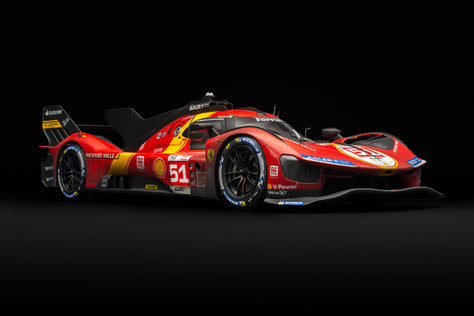
Ferrari 499P - Hypercar #51 - 2023 Le Mans Winner - Race Weathered - 1:8 scale 1:8 SCALE

Pre-order
Bespoke
In order for us to create your bespoke model, you will need to choose 4 extra options. Paint colour, interior colour, wheel style and caliper colour.
Please complete the form and a member of our Sales Team will contact you.
Contact Us
Please contact us for more information about ordering this model.